It has been months since the COP10 delegates left Panama City but, it appears, their brief residency is still causing problems in the country.
Just as when the circus big top leaves town, it is left to the locals to clear up the sawdust and litter, so it is that Panamanian authorities are still beset with the aftermath of the WHO event.
Eldigital Panama reports that the contract for hosting the conference, awarded by the Ministry of Health (MINSA), has attracted a complaint of “alleged crimes of fraud in public procurement, illicit association, ideological falsehood and against computer security.”
Accusing MINSA of “deception”, the complainant alleges that the procurement process for awarding the contract was flawed, contravened “the principles of transparency, equality and free competition”, and demands that those responsible be brought to trial.
This is yet more controversy for the organisers of COP10 after the country was outraged by the $4,881,732.20 spent for a tobacco conference while Panama’s health authorities were being starved of funding for incubators, as Copwatch reported last summer.
Eldigital Panama further comments on how “the National Oncology Institute faces serious budgetary limitations.” It could well have benefitted from the funding allocated to a junket for highly-paid tobacco controllers to chit chat about banning reduced risk nicotine products and treat themselves to lavish hotels and fine dining in the welcoming Latin American climate.
Copwatch mentioned last month that Dr Reina Roa, one of the WHO’s inner circle who has been elected President of the FCTC Bureau, would have been heavily involved in Panama’s preparation and implementation of dealings to host the COP10 conference.
This new report submitted to the Attorney General’s Office was filed “against whoever is responsible” for these crimes. Maybe, considering Dr Roa’s familiarity with the process, she could be of great assistance to the court by naming some names.
Considering the trials and tribulations that Panama has suffered for hosting the COP10 conference, what are the chances of other countries queueing up to do so in the future? There were certainly no takers for COP11, the WHO did not receive a single application, hence why it is now being held at WHO HQ in Geneva.
Well – we survived! Copwatch has been taking a breather, to digest what happened last month at COP10. Getting confirmation of what had happened took time, because the decisions were slow to arrive on the official website – presumably written to paint the event in the most positive light possible.
The live coverage on these pages revealed frustration amongst the FCTC ranks which was echoed by the head of the Secretariat, Adriana Blanco Marquizo, remarking at the end of the conference that her organisation had “survived”.
FCTC Pravda hailed “historic decisions” and announced that the meeting was a triumph, as it always does, but articles published by its allies expressed a lot of disappointment.
Where were all the delegates?
Even the FCTC Secretariat’s newsroom couldn’t hide the fact that there were deficiencies with the conference. Over 190 delegations would have been expected to arrive for the original staging in November, but the official record only counted “representatives from 142 Parties” as being in attendance.
Anyone who watched the live streams would have noticed a significant number of empty seats and made that assumption anyway. Copwatch estimates that there were up to 700 delegates missing between FCTC boasts in November and the official count post-event.
All the more amusing, then, that the WHO’s sole anti-vaping holdout in the Philippines, Pia Cayetano, has condemned the “huge” delegation sent by her country. One would have thought that sending a large delegation was a sign of support for the event. Copwatch suspects her objection would not have materialised if the delegates were paid-up members of Cayetano’s anti-harm reduction club rather than selected by the Philippines government to defend its admirable policy of embracing reduced risk products.
Interesting country statements
Cayetano was no doubt still seething at the Philippines’ prominent role during country progress statements in the (delayed) opening plenary. The country was one of many which challenged the WHO to consider harm reduction as a valid option to reduce the harms of combustible use. Furthermore, their statement made reference to Article 1(d) of the FCTC treaty which states categorically that harm reduction is one of the pillars of tobacco control, something that the FCTC authorities would rather ignore.
They were not the only delegation to do so. Disappointed pro-WHO groups moaned that “a number of countries, led by Guatemala and including the Philippines, China, Russia, Antigua and Barbuda, echoed industry talking points.” Translation: They didn’t fall into line with the favoured extremist policies suggested by the WHO.
Copwatch could add New Zealand, Guatemala, Armenia and El Salvador to that list, amongst others, and St Kitts and Nevis who played a starring role. More on that further down.
What triumphs?
But firstly, what were the triumphs that Adriana Blanco Marquizo was eager to trumpet?
Article 18 She was most enthused by the consensus achieved over Article 18 on the environment. The decision states that Parties must “have due regard to the protection of the environment and the health of persons in relation to the environment in respect of tobacco cultivation and manufacture within their respective territories.” It is very vague and will be something which is probably already being considered at national level .
Article 19 Likewise, the consensus decision on Article 19 which recommends Parties “strengthen their criminal and civil liability regimes, including administrative measures, to ensure accountability and deterrence, improve access to justice, and allow for effective remedies for those affected by tobacco harms.” Copwatch wonders what enthusiasm there will be for the many Parties with nationalised tobacco industries to take themselves to court.
Article 2.1
Article 2.1 was already a part of the treaty, but was bolstered by being included on the agenda. The decision recommends that Parties “identify and describe forward-looking tobacco control measures and measures that expand or intensify approaches to tobacco control as they apply to tobacco products.” Copwatch has a great idea. How about Parties identify harm reduction and the promotion of reduced risk products as a proven way of reducing the harms of combustible tobacco use? It fits the description perfectly.
Article 13 There was also a decision on Article 13 on tobacco advertising, promotion and sponsorship, mostly concerned with tackling posts on digital and social media channels which, again, is being discussed in many countries already.
Articles 9 & 10
One agenda item on which Parties could not reach consensus was on Articles 9 & 10 regarding regulation of contents and disclosure of tobacco products. Debate was ongoing for the entire week, taking up so much time that other items had to be shifted to the workload of Committee B for the duration.
An item in the GATC day 2 bulletin, written by Rob Cunningham of the Canadian Cancer Society and Deborah Arnott of Action on Smoking and Health in the UK, insisted that “Articles 9 and 10 deal with tobacco products, not e-cigarettes or other nicotine products.” Yet the agenda item encouraged delegates to consider report FCTC/COP/10/7 during discussions which, as Copwatch has written before, comments extensively on nicotine pouches and disposable vapes; dishonestly states that there is no evidence vaping can help people quit smoking; that even if they do, it does not constitute smoking cessation; that flavours are only attractive to adolescents; and points delegates to cherry-picked research on reduced risk products in the TobReg9 report.
Surely that is all wasted work if, as claimed, Articles 9 & 10 are not concerned with novel products? Perhaps this is why St Kitts and Nevis not only argued that the WHO needs to define harm reduction, but also introduced a proposal that Article 1(d) should be taken into account in deliberations over articles 9 & 10. And then the fight started.
Despite 5 days of debate, no consensus could be reached and they will go through it all again at COP11 next year.
Who wants to host COP11?
All in all, the decisions which reached consensus were rather limp and the conference in general rather underwhelming. Not particularly deserving of the term “historic”.
Finally, Copwatch would have liked to inform our readers where COP11 will be taking place but, sadly, the host country was not announced in the closing plenary. Evidently, there was no interest from any of the Parties and no applications to host were received.
One wonders what countries don’t find appealing about playing host to a two week opaque talking shop which attracts no tourists or media interest, nor offers infrastructure benefits, but comes with a $5 million price tag.
At nine pages, it is unusually long. Here are our observations:
Articles 9 & 10 (agenda item 6.1) has been postponed to COP11. This is no surprise – we have been reporting all week on how slow the progress on that agenda item has been.
There is a lot still to get through in the first session today, and only 3 hours to do it
An item of particular interest to us, Novel and emerging tobacco products (agenda item 6.3) is not resolved and is carried over to today’s business
Late evening meetings have been needed to force decisions, including on who the next Head of the Secretariat will be (agenda item 8.8) `
Please let us know if you think we have missed anything interesting.
There are still no decisions for this week posted on the Decisions page. So, we will keep watching for when those appear.
Today’s GATC bulletin From today’s GATC bulletin we learn that:
COP is expected to take up two sessions today, finishing in the evening. We had reported yesterday that there were still a lot of agenda items to get through.
Philippines is the latest country to be dignified with a ‘dirty ashtray’ award, for ‘its brazen use of tobacco industry tactics of obstinate dispute and delay throughout the COP’. The Philippines is included in our Interesting country statements article, their statement at the livestreamed debate included:
‘we emphasize the importance of a tailored multi-sectoral approach to FCTC implementation, acknowledging Article 1D of FCTC, varying national context and priorities, and domestic legislation.’ The link to the Philippines statement is here.
GATC indignation The GATC bulletin displays a palpable sense of indignation. Frustrated that the decision on articles 9 & 10 was deferred to COP11, the editorial complained of “just the amount of diversion and distraction that seemed intentionally disruptive at times.”
The author was particularly irritated that the term “harm reduction” was used. The adoring FCTC fan club has deluded itself that harm reduction is a tobacco industry fabrication rather than a real life concept with its own Wikipedia page and is an obligation (much ignored) of the FCTC treaty in article 1d of the preamble.
The editorial also claimed that parties were “confused” about the difference between a working group and an expert group. To clarify for our readers, the former is a group open to all Parties to join, whereas the latter is a group of so-called ‘experts’ cherry-picked by the Convention Secretariat to force through its perverse ideology. See Clive Bates’ Commentary on the annotated agenda (page 5) for more on that.
GATC’s assessment of the week
The bulletin also carries an account of the experience of a first-time COP attendee from the Philippines. Having been suitably brainwashed, she moaned about how delegates had not clamped down hard enough on “electronic smoking devices”.
“Clearly, the tobacco industry is creating a new generation of nicotine addiction with these emerging products”, she claimed, blissfully ignorant of the fact that tobacco companies provide a tiny proportion of the vaping market and that the products have been saving millions of lives worldwide.
Remember, you are paying for this delusion through your taxes.
Will there be any live streaming from COP10 today? This tile has appeared on the COP10 website, so it looks as though a press conference will be streamed:
We had thought that the final session might be streamed, and perhaps it will. However, it is unlikely to be as interesting as the debate we saw on days one and two this week, which featured the statements from some of the Parties.
The announcement of where COP11 will be held will come later. That honour probably won’t be going to a Dirty Ashtray award winner.
The Journal includes an overview of what business the COP will address for the day, and a report on the previous day. From the report section, we see that Committee A’s deliberations over agenda item 6.1, concerning Articles 9 & 10, are still not resolved:
Also, that two agenda items have now been transferred from Committee A to Committee B – an indication that the discussions over item 6.1 are taking much longer than anticipated.
We have also noticed that the Decisions section on the COP10 website has no documents from this week- is this because no decisions have been made, or because decisions haven’t yet been published?
Canada, El Salvador, Guatemala, Guyana, New Zealand, Philippines, St Kitts and Nevis and the United Kingdom are all featured in there, and we have linked to a separate image file for each statement.
NGOs behaving badly We are so bored of writing about them but they will keep on doing awful stuff.
GATC tweeted its Golden Orchid and Dirty Ashtray awards just before the sessions started – clearly intended to intimidate the Parties as they got down to COP business:
We assume that Singapore has been obediently pushing for the Expert group – see our earlier update for more on that. However, we have no idea what the Dominican Republic’s perceived sins are.
Media coverage on COP10 Media interest in COP is picking up a bit. This article from ULYS media in Kazakhstan describes an incident during one of the live streamed sessions:
“Jamilya Sadykova, a well-known anti-tobacco activist in Kazakhstan, appeared on the monitor and took a place in the delegation hall with representatives of our country. In this peculiar queue to the podium of the conference, she, violating etiquette, tried to attract attention to herself and tried to communicate with the head of the Kazakh delegation from the Ministry of Health.
– This is not the first time. There have already been similar incidents at other COPs when Jamilya took it upon herself to make statements on behalf of the Republic of Kazakhstan, explain members of the delegation.
They are trying to understand what goals Sadykova is pursuing and assume that these are her personal interests associated with private organizations and the American billionaire Michael Bloomberg.”
Delegates behaving badly at COP, who knew?! Do read the full article, it also reports on demonstrations by farmers outside the Convention Centre.
Panama authorities T-shirt crackdown There was a commotion on Tuesday as Panamanian authorities flexed their muscles. Panama Radio reported that “the Public Health team of the Metropolitan Health Region carried out an operation in four hotels in the town after a complaint about the distribution of pamphlets and t-shirts focused on the consumption of tobacco and its derivatives.” This was apparently unacceptable “because it affects the public health of the population.”
Copwatch has discovered the nature of these lethal materials. They are t-shirts worn by vaping consumer advocates and flyers produced by consumer associations to be handed out to delegates at COP explaining salient points of harm reduction and politely asking them to consider consumer concerns. The Panamanian public are no doubt reassured that the full force of the state has been employed to stamp out such dangerous threats to the safety of the country’s citizens.
Copwatch understands that the Good COP event at the Central Panama Hotel in Casco Viejo was visited by representatives of the Bloomberg-funded Campaign for Tobacco Free Kids yesterday. They were greeted by Taxpayers Protection Alliance staff and invited to register for the event. Sadly, they left soon after but we hear their names are recorded at the TPA reception desk and their lanyards are available to pick up at their convenience.
The agenda items included in yesterday’s Journal included several for Committee A, under ‘Item 6 Treaty and technical matters’. This included item 6.1 Implementation of Articles 9 and 10 of the WHO FCTC.
We wrote about this agenda item in our update yesterday, asking: Will Parties relinquish control to the Expert group (Articles 9 & 10)? From the GATC bulletin Day 4 we learn that there has been a struggle in Committee A. GATC is very annoyed 😂
“We appeared to be in some sort of dystopian COP yesterday in Committee A – was anyone else in the same alternate universe we were in? A world where COP Rules of Procedure can be blatantly ignored, the scope of FCTC Articles magically expanded, advice from WHO legal rejected and the entire history of how the COP operates forgotten or thrown out the window?”
The discussions over Articles 9 & 10 did not go according to the Canadian NGO’s plan:
“We would like to take this opportunity to remind Parties of the necessity of adopting the proposed draft decision in relation to Articles 9 and 10”
The discussion has taken up a day and a half!
That draft decision includes Parties surrendering control to an Expert group, on a very weak mandate. In reference to this Clive Bates wrote:
Copwatch is delighted to hear that Committee A is discussing this thoroughly. It is a relief to hear that some Parties in Committee A are conscientiously considering decisions which affect millions of lives – and not being railroaded by the Secretariat, the Bureau and unelected NGOs.
Country statements Of huge interest to COPWATCH’s consumer advocate audience has been the statements given by the countries, during agenda item 5. These have been live streamed over days one and two.
All three videos can still be viewed on the COP10 home page, look for these tiles:
Later we will bring you excerpts from the transcripts, highlighting those statements which mention harm reduction.
If anyone is producing video clips of the individual country statements please let us know – we would love to include those in upcoming Copwatch updates
Organised by the Bloomberg funded NGOs and designed to pressurise the Parties, it is good to see that these official side events are getting a healthy reaction on social media.
Countries gave statements during agenda item 5 at COP10. These were live streamed over days one and two. At the time of writing the videos were accessible via the COP10 homepage. We posted the full transcripts here: 1, 2, 3.
In this article we post the individual statements which we think are interesting, with a brief explanation of why we have included them. Are there any other statements you think we should include? Let us know.
Armenia – asks for harm reduction to be considered: “we believe that alternative methods of reducing the negative health impacts of smoking should be considered on the firm basis of scientific research and conclusions in order to take informed decisions on how to minimize the harm of smoking within that particular segment of our society.” Link to statement, here
Canada – no mention is made of harm reduction, conflicts with the national policy? Link to statement, here
El Salvador – asks for further studies and information to analyse the impact of novel products Link to statement, here
Guatemala – raises a point of order over how consensus is reached at COP Link to statement, here
Guyana – calls for a ‘serious and evidence-based discourse on harm reduction’ Link to statement, here
New Zealand – states that their national approach ‘involves a considered implementation of evidence-based harm reduction measures’ Link to statement, here
Philippines – ‘we emphasize the importance of a tailored multi-sectoral approach toFCTC implementation, acknowledging Article 1D of FCTC, varying national contextand priorities, and domestic legislation.’ Link to statement, here
St Kitts and Nevis – ‘‘the tobacco control community should not reject the idea of harmreduction per se but we should learn from the best practices of proven public healthoriented measures while preventing the tobacco industry from hijacking that important term’, calls for a working group to be established Link to statement, here
United Kingdom – no mention is made of harm reduction, conflicts with the national policy? Link to statement, here
Live streaming of the country statements Yesterday was Day 2 of FCTC COP10 in Panama. Tobacco harm reduction advocates were pleased to see some transparency brought to the proceedings, with the continued live streaming of the country statements at item 5 (videos are on the COP10 website). As with Day 1, there was no indication given of when the live streaming would start, but we were nonetheless pleased when it finally started blaring out of our devices.
Yesterday we published a transcript of Day 1’s live streamed session, you can find that here. We hope today to publish a transcript of Day 2. Highlights were St Kitts and Nevis, Armenia, El Salvador, the Philippines. The United Kingdom’s statement was disappointing, and seemed to go against assurances that minister Andrea Leadsom had made to MPs, just a few weeks ago. We’ll bring you more on those country statements another time.
GATC updates (why not spend some Bloombucks on a better website?) The official propaganda mouthpiece of COP, GATC, is finally chucking out some semi informative articles. It’s just a shame that their newly revamped website is impossible to navigate. Despite Parties having the decision making powers, the tone of the GATC updates is of irritation. GATC – an unaccountable and unelected NGO – sounds annoyed that Parties might not do as they wish them to do. Of course, GATC knows best! And, those pesky Parties will keep trying to mess with the agenda!
DAY 1
Oh, the irony……
We only had a few agenda items to get through today, notably adopting the agenda, and even that proved to be extremely difficult. Day 1 of COP10 started off with Parties proposing to merge agenda items in an attempt to be more efficient. While in reality, the discussion had the opposite effect and consumed valuable time. We all witnessed the frustrating impact of time spent discussing issues with no productive outcomes. Today was very instructive on how the rest of the week should not be conducted.
This smug ASH update is also blatant about the NGO’s mission to influence Parties:
February 6, 2024 – A typical day at the Conference of the Parties begins very early and ends very late, and today was no different.
At 7:00 AM, ASH begins by meeting with our civil society allies to discuss strategy for the day. Starting at 9:00 AM, we attend meetings with country Parties. The official Committee meetings begin mid-morning and run late into the evening. ASH is here to listen, take notes, engage with Parties and civil society partners, and occasionally make interventions to advocate for our priorities.
Will Parties relinquish control to the Expert group (Articles 9 & 10)?
A ‘day 2’ update in the GATC COP bulletin is written by tobacco controllers Deborah Arnott and Rob Cunningham.. The point of the article is to ‘urge’ Parties to give away some of their powers.
“One of the critical decisions Parties will make this week is whether to approve the creation of an Expert Group for Articles 9 and 10…”
Here is what Clive Bates wrote about that proposal:
Having denied Observer status or even entry to the public gallery to thousands of members of the public and grass roots advocates, we see a continued attempt at COP to show that ‘civil society’ supports what the unaccountable NGOs want at COP10.
As with the Participants list, Bloomberg funding is obvious – but we don’t have time to research whether that applies to absolutely all of them. What is clear though is that GATC has played a leading role in assembling them:
It is outrageous that the GATC – an unaccountable NGO – can seek to influence proceedings in this way. We hope that other parties will not take note.
Do read this excellent article from Philstar on the Orchids and Ashtrays: Absurdity at its worst
“It’s simple: if a COP party or member-country sticks to the agenda and closely aligns itself with the WHO FCTC’s proposed policies, they are given an Orchid Award. On the other hand, if a country ventures to speak about tobacco as a positive force economically or attempts to present proven science on less harmful alternatives to smoking, then they are given the odious-sounding Dirty Ashtray Award.”
We have now generated a transcript from the livestream video of the opening session – LINK to ‘COP10 opening session transcription’. Please note that it is unedited and might contain errors. The video itself is still accessible on the COP10 homepage – look for ‘Live streaming’.
Statements made by some of the Parties yesterday – EU, China, New Zealand, the Philippines, the UK (disappointing!) – are especially interesting to read. Those statements appear towards the end, so scroll down.
COP business resumes today with this general debate, starting at 10 a.m. :
However, you could be forgiven for forgetting that – so far COP10 is a Bloomberg fest.
Here’s some of what we observed of COP10 on Day 1, from our position firmly outside the tent.
The five hour delay
The opening session in Panama was to be livestreamed, from 10.00am ET. However, without any official explanation, the livestream didn’t start until 5 ½ hours later.
Why so late? We can only guess that the exclusion from COP of democratically elected congressmen from Brazil, and the involvement of the Brazilian ambassador, had something to do with it. We imagine that Panama would not welcome a diplomatic incident with Brazil.
“The expectation is to return the accreditation by the end of the day. A meeting on the evening of this Monday, 5th, between state deputies Marcus Vinícius de Almeida (PP), Edivilson Brum (MDB), Zé Nunes (PT) and Silvana Covatti (PP) and ambassador Carlos Henrique Moojen de Abreu e Silva seeks to detail the demands and the search for participation in COP10.”
Watch this video from El Mono Vapeador, filmed before security guards ejected him from the Convention Centre. Includes an interview with some of those trying to get admitted to COP.
The delay in the livestreaming even confused people inside, with the director of Expose Tobacco retweeting Copwatch (Expose Tobacco does not like Copwatch!).
The official proceedings
We will bring you more on the opening session in a later update. The video for the livestream is still up, on the COP10 homepage – look for ‘live stream’ towards the bottom. We are watching it now – the statements from national delegations are likely to be the most interesting part of the proceedings.
That’s all for now. We’ll finish with our short message to delegates:
Delegates – you are representing your countries. You are the decision makers at COP. We trust you to look behind the propaganda. We trust you to read the official documents, not just what the official NGOs are saying. We trust you to do the right thing for people who smoke and who need access to safer nicotine products to improve their health.
Here is a list of Copwatch’s #COP10 articles, listed with the most recent first.
5 – 9 February 2024 Copwatch live Copwatch live reports during COP10 week
8 February 2024 Interesting country statements made at #COP10 Countries gave statements during agenda item 5 at COP10. These were live streamed over days 1 & 2. In this article we post the individual statements which we think are interesting, with a brief explanation of why we have included them.
4 February 2024 #COP10 is here! “The official event takes place in the Panama Convention Center. There are also unofficial events taking place, notably the Good COP event. Here we give you information about the official and unofficial events.”
26 January 2024 #COP10 – full steam ahead “The propaganda assault on safer nicotine products and those who advocate for them is at fever pitch. Bloomberg has poured a lot of money – ‘Bloombucks’ – into attacking tobacco harm reduction and journalists for hire are working overtime to smear anyone who speaks up for it.”
10 December #COP10 Catch Up “Quite a bit happened with COP10 since we last posted. Here we bring you up to speed. Copwatch had been reporting since April that there was a problem with the contract to put on COP10.”
7 November Even bigger big trouble in little Panama “The upshot is that, with less than 2 weeks to go, the WHO has booked a convention centre in which to hold COP10 but has no-one to organise it. Delegates may be arriving in Panama City all dressed up but with nowhere to go.”
3 November FCTC: Does it work? #COP10 “This supplementary document does a far better job than the ‘main document’(10/4) in describing progress made against the ultimate objective, which is to reduce death and disease from smoking.”
31 October Another anonymously-written WHO paper is misleading Parties to #COP10 “Two weeks ago, Copwatch drew attention to an anonymously-written paper designed to gaslight Parties at COP10 about disposable vapes. There is a similar attempt at gaslighting going on with a second document in the same series, this time on nicotine pouches.”
27 October Human rights alert at #COP10 “The FCTC Secretariat is working behind the scenes to impose a narrow view on human rights and tobacco within the UN system and amongst countries (the Parties to the Convention).”
25 October A vaper’s call to the delegations to #COP10 “Here we publish a powerful plea from a vaper in the Philippines to the delegates who will be meeting at COP10 in Panama next month.”
23 October FCTC budget: nice work if you can get it Here Copwatch brings you what you need to know about the COP10 documents relating to the FCTC budget. This covers three documents: FCTC/COP/10/17, FCTC/COP/10/18, FCTC/COP/10/19 Rev.1
16 October The WHO publishes anonymously-written papers designed to gaslight Parties at COP10 Copwatch has detailed many instances of the WHO and FCTC Secretariat playing fast and loose with evidence or cherry-picking research to suit its anti-harm reduction agenda. It is unscientific and shameful but nothing we have not seen before. But two new reports, on disposable vapes and nicotine pouches, have been published on a separate page to the main COP10 menu which seem specifically designed to mislead COP10 delegates based on nothing more than opinion.
10 October COP10 documents guide: FCTC/COP/10/4 “Produced by the Convention Secretariat, the subject for the report is ‘Global progress in implementation of the WHO FCTC’.”
28 September Alternative reading list for #COP10 delegates COPWATCHERS will notice that tobacco harm reduction is absent from the official documents, with no consideration given to the opportunities offered by safer nicotine products. Here we have compiled a list of articles to round off the COP10 delegates’ education.
24 August #COP10 documents guide: FCTC/COP/10/9 “Having airily skipped over the yawning chasm of missing research that they were supposed to have gathered on heated tobacco in just four pages, the FCTC/COP/10/9 document then spends the rest of the 18 pages discussing what bans and restrictions should be put in place.”
18 August More trouble in little Panama “In June, Copwatch mentioned, in passing, that a series of nationwide protests and blockades had taken place in COP10 host country, Panama, recently. Cost-of-living concerns, mistrust of government officials, poverty, inequality and corruption have led to much discontent.”
3 August The WHO releases new report on the ‘tobacco epidemic’ and how to maintain it “Cynical people (unlike those at Copwatch, of course) might assume that there is some cherry-picking going on for inclusion of evidence for the report, while Bloomberg’s anti-nicotine minions are given pay-to-play access to write it”
31 July The road to FCTC #COP10 “Going from the agenda we can expect a fully packed discussion on substantive items. Readers will remember that COP9 was virtual and that although discussions were tortuous (refresh your memory with our COP live reporting), there was no discussion on ‘substantive items’. This in person COP10 in Panama promises to be a proper bun fight – and we just wonder whether the allotted week will be sufficient.”
29 June Big trouble in little Panama “The World Health Organization is often criticised for incompetence in a number of its policy focuses, not solely for its calamitous, head-in-the-sand position on lower-risk alternatives to smoking. But in the practice of handing awards to its buddies, it can only be described as a triumphant global expert”
6 June Yet another murky WHO meeting “No-one outside of the WHO FCTC bubble will be allowed to view this latest secret meeting, nor do we expect to see published minutes.”
1 June Consumer groups challenging the WHO FCTC – Who will be next? “WHO appointees to the FCTC Bureau and Secretariat have always thrived under the cloak of secrecy they cleverly weaved around preparations for COP conferences. They have been mostly unchallenged when ignoring evidence on the effectiveness of safer nicotine and peddling their anti-harm reduction agenda to member delegations. But it appears consumer groups all around the world are alive to their antics this year.”
9 May April – victory month for harm reduction For the first time in UN history the notion of harm reduction appeared in the politically negotiated UN resolution on drug policy. Until then harm reduction had only been mentioned in the context of HIV/AIDS. The resolution adopted at the 52nd session of the Human Rights Council mentions a harm reduction approach among other health responses and underlines that support for harm reduction is not qualified as being subject to national legislation.
3 May Introducing the authors of the COP10 agenda – the FCTC Bureau “Copwatch decided to investigate by looking at the make-up of the FCTC Bureau, the body which will be writing the agenda. It would be preferable if they published their November and March meeting minutes so we could read the plans first-hand but, as Copwatch reported previously, it seems their typewriter is still at the repairers.”
25 April The WHO meetings that never are or were “Although we know that this GTRF meeting is taking place in India this week, that is all we will ever know. It seems that the WHO has only two rules on the matter. The first rule is that they do not talk about GTRF. The second rule is: they DO NOT talk about GTRF!”
20 April Who is the new WHO French guy? “the WHO’s new head of policy on tobacco and nicotine has shown he is incapable of understanding quantitative research, is willing to massage scientific data to hide inconvenient facts, refuses to listen to consumers, and is ideologically opposed to vaping despite its track record of reducing smoking rates in his country.”
11 April Panamanian party poopers? “The last Copwatch post reported on Dr. Reina Roa, who has accepted an award from Bloomberg Philanthropies and is now being investigated by Panamanian authorities for “administrative irregularities” over what is a clear conflict of interest in her role as an “independent” adviser to the Ministry of Health.”
3 April Where’s Bloomby? Check the atlas “The latest target of Bloomberg’s ongoing programme to influence government policies in low and middle income countries is Panama. Yes, the Panama where COP10 will be held later this year. That Panama.”
23 March We had a dream…. “Yet again, we will hear whining that there are no safer alternatives to smoking, and that tobacco and nicotine products should be banned. Just not the cigarettes.”
1 March Where are the FCTC Bureau meeting minutes? “The second meeting of the FCTC Bureau took place at the end of November 2022, but here we are at the start of March and the minutes of their last meeting have still not been published. Has their typewriter broken?”
1 February Key milestones for COP10 We provide a graphic of the key milestones leading up to COP10, and opportunities for engagement.
10 February Is the FCTC’s website now a Bloomboard? “Yet another day, yet another connection of Bloomberg with the Secretariat of the Framework Convention.”
The propaganda assault on safer nicotine products and those who advocate for them is at fever pitch. Bloomberg has poured a lot of money – ‘Bloombucks’ – into attacking tobacco harm reduction and journalists for hire are working overtime to smear anyone who speaks up for it. This media manipulation will be familiar to advocates but still raises eyebrows – it’s arrant hypocrisy when the Bloomberg funded media attacks advocates for perceived conflicts of interest.
‘Any government pursuing a smoking cessation strategy using e-cigarettes should control the conditions under which the products are accessed to ensure appropriate clinical conditions and regulate the products as medicines’
Vapes are effective because they are consumer products; that is fundamental to their success in helping people to quit smoking. We don’t know of any medicinally licensed vaping products. So WHO is now calling for countries who have legalised vapes to ban them.
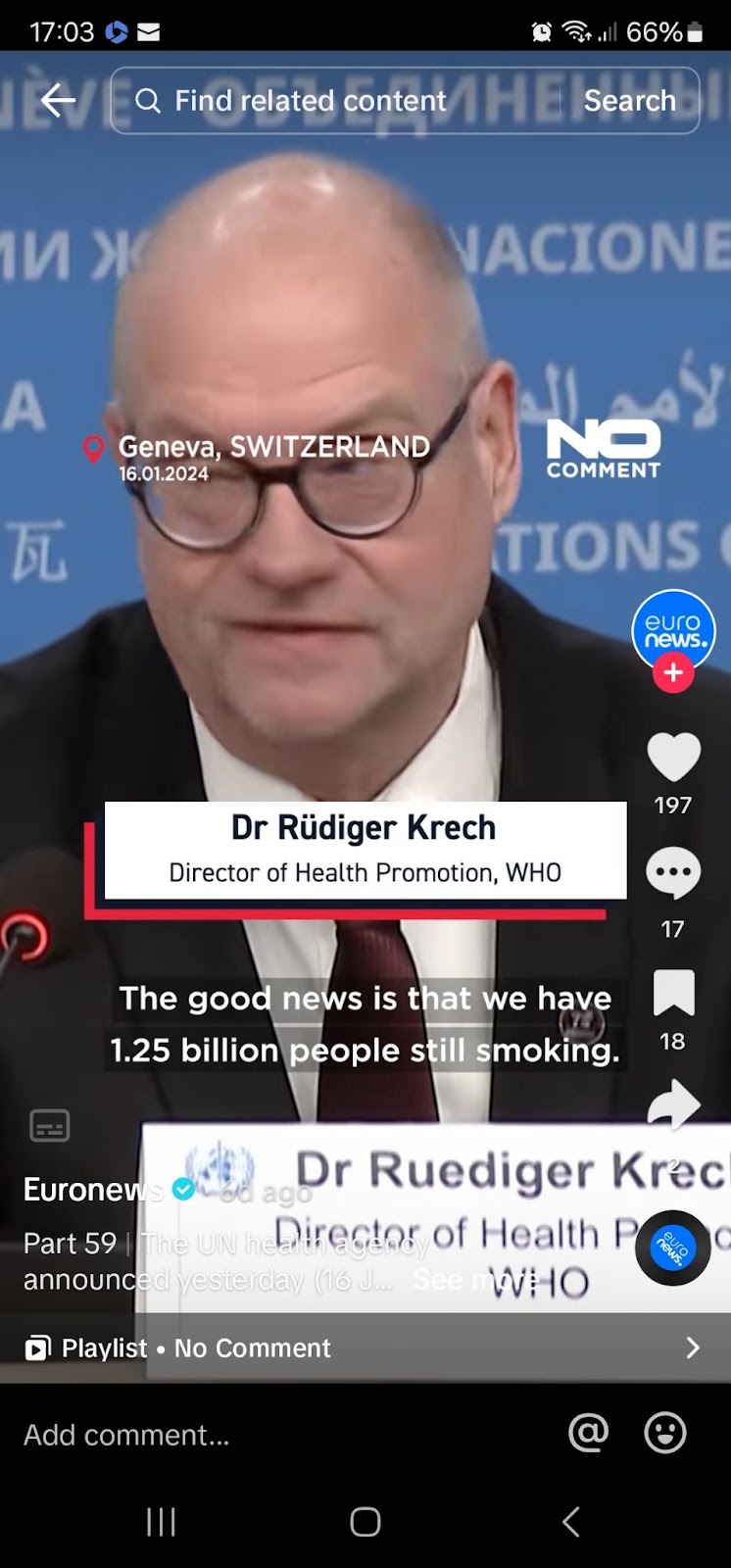
Check out too what Rüdiger Krech, WHO’s Director for Health Promotion said on 16 January in a press briefing – watch here from 22.50 in: https://webtv.un.org/en/asset/k1f/k1fpinodpy
And, TikTok has this video with Krech saying it’s good news that 1.25 billion people still smoke. The quiet bit said out loud?
Happily, some of WHO’s disinformation is being challenged, at least one of their tweets has earned a Community Note.
More trouble in Panama over the $5million hosting of COP10 🍿
Not only is there dissatisfaction over the Panama government spending $5million on the contract, a complaint has been filed over how the contract was awarded. It has been revealed that the contract was not put out to tender and there is now an official complaint. Read more on these links:
We have reported several times on the controversies surrounding Panama’s hosting of COP10, see our COP10 articles list if you are interested in reading more.
And, Panama’s Ministry of Health (MINSA) recently put out a press release stating that ‘delegates from 183 countries are expected, with about 1,900 people (1,200 for the COP and 700 for the MOP)’.
Official documents
Participants list
Back to Bloomberg – do check out the participants list, published after the de minimis session. There’ll be a big Copwatch thumbs up👍🏽for anyone who can identify how many of the Observers are funded by Bloomberg – we can see it’s a lot but we don’t have time to research the full list. In contrast, not one organisation which speaks on behalf of people who use nicotine has been granted observer status. And, we are hearing that applications from the general public to attend the COP open sessions are being rejected, including from tobacco growers in Brazil:
‘In October, the Minister of Agriculture, Carlow Fávaro (PSD), had confirmed to parliamentarians that the Brazilian government would grant access to the event to representatives of the population. However, those who registered on the official website of the World Health Organization had their application rejected without official justification’. (Google translate)
What makes it even worse is that WHO is evidently familiar with the concept that those most affected should be involved in decisions which affect them. In 2021 they produced a manual entitled ‘Nothing About Us Without Us’ #NoExcuse
And, we’d like to take this opportunity to remind you that Copwatch has delved into lots of the COP10 official documents over the past few months, check out our article list here: COPWATCH #COP10 articles
UK Parliament debate
Andrew Lewer MP moved the motion on COP10 to the WHO Framework Convention on Tobacco Control in a backbench debate on 18 January. The video is here and the Hansard (transcript) is here.
All MPs speaking called for a minister to attend as part of the UK COP delegation. Many MPs were concerned that the UK COP delegation might agree with policies which contradict domestic ones.
“In Panama, I want to hear the Minister using their power and the UK’s authority to stand up for solutions that work. I want the Government to stand by these arguments. NHS policy papers, the Khan review and ASH show that allowing people to make smaller changes leads to longer-term change. If we use our position as one of the FCTC’s largest financial contributors, our voice should be heard. I urge the Government to lead, and the Minister for Primary Care and Public Health to join COP10 as part of our delegation.” Virendra Sharma MP
It was brought to our attention that COPWATCH was mentioned in the ‘Media workshop in lead up to global tobacco treaty intergovernmental negotiations (COP10/MOP3)’, held on 23 January. Apparently it was said that although there is no proof that the tobacco industry funds us, it is strange that we go along with what the tobacco industry is doing.
We would like to put the record straight. No one funds COPWATCH. We are part of the proud global movement of grass roots consumers advocating for people who smoke to have access to products which can improve their lives. That movement has had many successes worldwide in resisting over regulation which would take life saving products away from the people who need them. We have been advocating for safer nicotine products for a long time, long before any of the tobacco industry. In fact, some of the tobacco industry is just saying what we said first. And, by no means is all of the industry pro tobacco harm reduction – just look at China Tobacco.
That’s all for now. We’ll leave you with some reading – an excellent letter from the Association of Vapers India, calling upon their delegation to use COP to learn from the positive experiences of nations which are open to tobacco harm reduction:
Quite a bit happened with COP10 since we last posted. Here we bring you up to speed:
COP OFF Copwatch had been reporting since April that there was a problem with the contract to put on COP10, this is from our article of 7 November:
“The upshot is that, with less than 2 weeks to go, the WHO has booked a convention centre in which to hold COP10 but has no-one to organise it. Delegates may be arriving in Panama City all dressed up but with nowhere to go.”Even bigger big trouble in little Panama
COP OUT So, it came as no surprise to us when on 9 November it was announced that COP10 would be postponed. The Secretariat’s press release stated that the postponement was at the request of Panama and “due to the current security situation in Panama”. However, Copwatchers will find it hard to believe that the problems with the COP10 contract, and the whiff of corruption around it, had nothing to do with the decision. See Vaping Today’s recent article, here, for an in depth analysis of the various issues.
The Journal for the de minimis session is thin, but it does give these ‘official’ hashtags for COP10: #COP10FCTC and #COP10 (both hashtags are currently dominated by consumer advocates for tobacco harm reduction).
A few days later – the money now being in place – the new dates for the in person COP10 in Panama were announced: Monday, 5 February to Saturday, 10 February 2024
Delegates list A huge bonus for those who appreciate transparency (not you, FCTC Secretariat) is that the delegates list for the de minimis session had to be published:
Usually we have to wait until after COP to see who the delegates are – despite them all being funded out of the public purse! Publishing the list in advance means that delegates can be contacted by the actual public. It offers a rare opportunity for those who are most affected by the decisions taken at FCTC COP to have a say. So, get writing, people!